
Shape the stiffness of the tip
In this tutorial we ask how stiff the soft arm is at its tip, choose the stiffness we want, and let the controller find the springs that give it. Then we correct a position that the arm’s own stiffness holds back, with a sensor and without one.
The stiffness at the tip
A spring pulls the tip to a goal, as in your first controller. The spring’s stiffness is a matrix, so that it can differ along each axis. We let the arm settle:
import numpy as np
import matplotlib.pyplot as plt
import virtualmodelcontrol as vmc
from virtualmodelcontrol.robots import helyx

arm = helyx.add_dynamics(helyx.arm("145-145-145"))
tip = arm.point(s=1.0)
goal = np.array([0.08, 0.0, 0.40])  # [m]

ctrl = vmc.Mechanism("ctrl")
reach = vmc.LinearSpring(tip - vmc.Ref("goal", 3, value=goal),
                         300.0 * np.eye(3))  # [N/m]
ctrl.add("reach", reach)
ctrl.add("damp", vmc.LinearDamper(tip, 5.0))
ctrl.add("gravity", vmc.GravityCompensation(arm))
compiled = vmc.compile(vmc.VirtualMechanismSystem(arm, ctrl))
controller = vmc.VMCController(compiled)
plant = vmc.sim.ModelPlant(arm)

def settle(seconds):
    dt = 1 / helyx.CONTROL_RATE
    for _ in range(int(seconds / dt)):
        plant.write(controller.step(plant.t, plant.read()))
        plant.advance(dt)
    plant.write(controller.step(plant.t, plant.read()))

settle(2.0)
A push \(\delta\) of the tip along \(x\) is met by a force \(K_{xx}\delta\) along \(x\) and, if \(K_{xz}\)
is not zero, by a force \(K_{xz}\delta\) along \(z\). TaskStiffness gives the matrix \(K\) from
the controller and the model of the arm: the stiffness of everything that holds the tip, the
arm’s own and the springs’, with the changes of the geometry counted. Like the laws below, it
reads the controller’s motors, so it does not run on a StateController
(Robots with fewer motors than joints).
from virtualmodelcontrol.estimation import TaskStiffness

stiffness = TaskStiffness(controller, site=1.0)  # the tip
K = stiffness(controller)  # [N/m]
K.round(0).astype(int)
array([[ 392,    0,  427],
       [   0,  293,    0],
       [ 427,    0, 2141]])
Along \(x\) the tip is 392 N/m stiff and along \(y\) 293 N/m, for a spring of 300 N/m. Along \(z\) it is 2141 N/m: the arm is stiff along its length. The arm is bent a little, so the axes mix (427 N/m between \(x\) and \(z\)). Only the matrix of the springs is ours to change.
Ask for a stiffness
Say we want the tip stiffer than it is by 200 N/m along \(x\) and \(y\) and by 600 N/m along \(z\).
StiffnessTracking takes the live stiffness Params and finds the ones that give a wanted
matrix. The task-space stiffness is affine in the springs’ stiffness, so it solves a linear
system, and takes the solution of smallest norm.
from virtualmodelcontrol.adaptation import StiffnessTracking

wanted = K + np.diag([200.0, 200.0, 600.0])  # [N/m]
law = StiffnessTracking(controller, site=1.0, params="ctrl.reach.stiffness")
history = [np.diag(K)]
for _ in range(3):
    law.step(controller, wanted)
    settle(2.0)  # the arm moves a little, and the matrix changes with it
    history.append(np.diag(stiffness(controller)))
history = np.array(history)
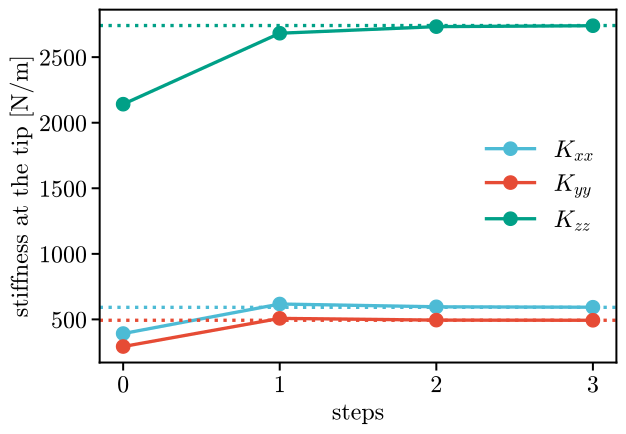
Each step moves the Params all the way to what the model says gives the wanted stiffness. The arm
then moves a little, which changes the matrix, so a few steps close the gap: after three the
diagonal is within 0.1% of the wanted one. The spring along \(z\) ends at
989 N/m. The stiffness the arm has by itself stays, so a stiffness below
that is out of reach: the springs cannot be negative, and a step stops at zero. The step
keeps every stiffness matrix symmetric and positive semidefinite. fraction moves only a part
of the way at each step, and a tank takes the controller’s energy into account when
passed in place of the controller.
Put the tip where we want it
A spring with a stiffness of 300 N/m does not bring the tip to its goal: the arm’s own stiffness holds it back.
controller.set({"ctrl.reach.stiffness": 300.0 * np.eye(3),
                "ctrl.reach.goal": goal})
settle(2.0)
How far is the tip from the goal now?
kin = vmc.Kinematics(arm)
miss = np.linalg.norm(goal - kin.position(plant.q, 1.0))  # [m]
1e3 * miss  # [mm]
np.float64(21.981241488329417)
The goal is only a place where the spring would be at rest. PositionRegulation moves it by
integral action: at every step it adds a share of the position error to the goal (gain, here
2 %), until the tip is at its target. The dictionary names the goal and the point that its
spring pulls, here the tip at \(s = 1\).
from virtualmodelcontrol.adaptation import PositionRegulation

regulate = PositionRegulation(controller, {"ctrl.reach.goal": 1.0},
                              gain=0.02)  # the goal, and its point
errors = []
for _ in range(int(4.0 * helyx.CONTROL_RATE)):
    plant.write(controller.step(plant.t, plant.read()))
    regulate.step(controller, {"ctrl.reach.goal": goal})
    errors.append(np.linalg.norm(goal - kin.position(plant.q, 1.0)))
    plant.advance(1 / helyx.CONTROL_RATE)
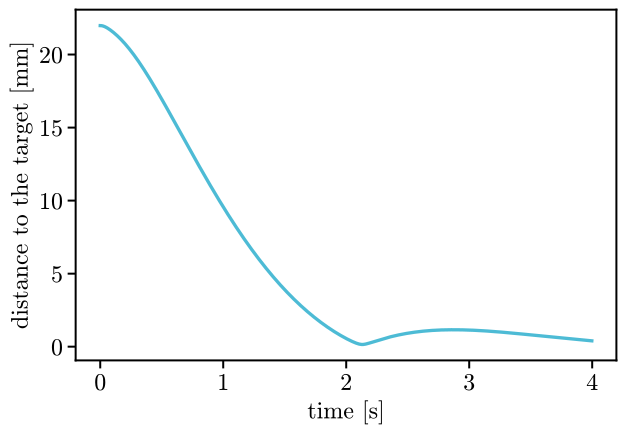
The tip starts 22 mm from the target and ends 0.40 mm from it. To get there the goal moved 128 mm away from the target, much more than the error: the arm’s own stiffness holds the tip back, so the spring has to stretch far to push it the last millimeters. No model of the arm’s stiffness or weight was used, only the position of the tip.
Hold a pose without a sensor
The integral action needs to see the tip. Without a sensor the model can do the same job once:
HoldingGoals puts each goal at the place we want its point to be, plus the offset that lets
the spring carry the arm’s own stiffness and weight. It is one Newton step on the static
balance, taken at the pose the arm has now, and the offset is the smallest one that does it.
The springs must be able to balance every motor, so we use three of them along the arm, for its nine motors. First we leave each goal at its point, as if the arm had no stiffness of its own:
from virtualmodelcontrol.adaptation import HoldingGoals

ctrl3 = vmc.Mechanism("ctrl")
sites = {}  # the live goal of each spring, and the point it pulls
for i, s in enumerate((0.5, 0.75, 1.0), 1):
    anchor = vmc.Ref(f"g{i}", 3)
    ctrl3.add(f"s{i}", vmc.LinearSpring(arm.point(s=s) - anchor, 200.0))
    sites[f"ctrl.s{i}.g{i}"] = s
ctrl3.add("damp", vmc.LinearDamper(tip, 5.0))
ctrl3.add("gravity", vmc.GravityCompensation(arm))
compiled3 = vmc.compile(vmc.VirtualMechanismSystem(arm, ctrl3))

# the arm's start
bent = 0.01 * np.array([1.0, 0.6, -0.4, 0.8, -0.6, 0.0, 0.4, 0.2, -0.4])
kin = vmc.Kinematics(arm)

def ready():
    """A controller and a plant, at rest in the bent pose."""
    plant = vmc.sim.ModelPlant(arm, q0=bent)
    controller = vmc.VMCController(compiled3)
    controller.reset(0.0, plant.read())
    controller.step(0.0, plant.read())
    return controller, plant

def hold(offset, seconds=3.0):
    """How far [m] the tip goes from where it started."""
    controller, plant = ready()
    if offset:
        HoldingGoals(controller, sites).step(controller)
    else:
        controller.set(
            {n: kin.position(bent, s) for n, s in sites.items()})
    start, dt, away = kin.position(bent, 1.0), 1 / helyx.CONTROL_RATE, []
    for _ in range(int(seconds / dt)):
        plant.write(controller.step(plant.t, plant.read()))
        plant.advance(dt)
        away.append(np.linalg.norm(kin.position(plant.q, 1.0) - start))
    return np.array(away)

sags, held = hold(offset=False), hold(offset=True)
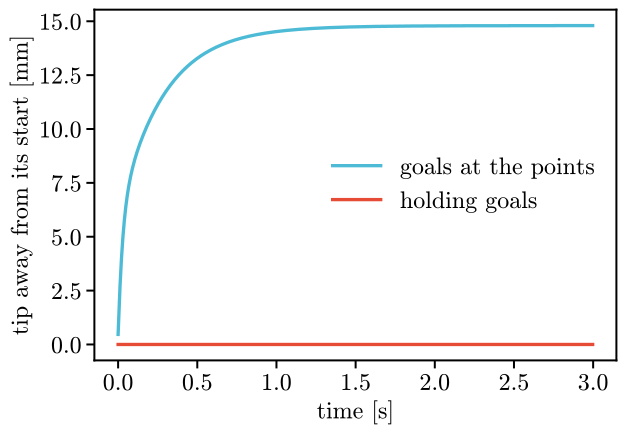
With the goals at the points the arm’s own stiffness pulls the tip 15 mm away.
With HoldingGoals it stays where it is, to less than a micrometer. targets takes other
positions, a dictionary from each goal’s name to where its point should be. The offset is
computed at the pose the arm has now, so the arm only gets near them; applying the step again as
the arm moves brings it closer.
aim = {n: kin.position(1.3 * bent + 0.005, s) for n, s in sites.items()}

def worst(q):
    """The largest distance of a point to its target."""
    return max(np.linalg.norm(aim[n] - kin.position(q, s))
               for n, s in sites.items())

def reach_aim(repeat):
    controller, plant = ready()
    law = HoldingGoals(controller, sites)
    law.step(controller, aim)
    dt = 1 / helyx.CONTROL_RATE
    for k in range(int(3.0 / dt)):
        plant.write(controller.step(plant.t, plant.read()))
        if repeat and k % int(0.1 / dt) == 0:
            law.step(controller, aim)
        plant.advance(dt)
    return worst(plant.q)

before, once, again = worst(bent), reach_aim(False), reach_aim(True)
The farthest of the three points starts 188 mm from its target, ends 44 mm from it after one step, and 4 mm from it when the step is applied every 0.1 s.
Track a contact force uses the same laws on a stiffness or a goal to reach a force instead of a pose, and Energy and passivity explains the tank that can limit them.