
Contact
In this tutorial we press a fingertip on a table with a chosen force, rub it along the table with friction, and use the same elements as a virtual wall that the controller enforces. Then we put contacts on other surfaces and between two points of a robot, such as an object squeezed between two masses, and end with how to choose the numbers.
Signed distances and contact springs
A contact needs a signed distance \(d\) from a robot point to a surface: positive outside, zero
on the surface, negative inside. A ContactSpring on \(d\) pushes the point out only while
\(d < 0\), with energy \(\tfrac12 k \delta^2\) for a penetration \(\delta = \max(0, -d)\). A
ContactDamper damps only during contact. Added to the robot mechanism, they model the
environment, which only the simulator feels. Added to the controller, they make a virtual
wall.
A finger above a table
The table is a plane 6 cm below the finger’s base. The finger’s \(z\) axis points down, so the table’s outward normal is \(-z\).
import casadi as ca
import numpy as np
import matplotlib.pyplot as plt
import virtualmodelcontrol as vmc
from virtualmodelcontrol import viz
from virtualmodelcontrol.robots import adapt

k = 1e4  # [N/m], a hard table
finger = adapt.add_dynamics(adapt.finger())
tip = finger.point("tip")
to_table = vmc.PlaneDistance(tip, normal=[0, 0, -1], origin=[0, 0, 0.06])
finger.add("table", vmc.ContactSpring(to_table, k))
finger.add("cushion", vmc.ContactDamper(to_table, 5.0));  # [N·s/m]
Press the table with a goal
A spring pulls the fingertip towards a goal below the surface. The tip stops on the table, where the spring’s pull balances the table’s push. The contact force is then about the spring’s stiffness \(K\) (100 N/m here) times the goal’s depth, a little less because the table gives way: \(K k / (K + k)\) times the depth.
K = 100.0  # [N/m]
goal = vmc.Ref("goal", 3, value=[0.0, 0.05, 0.06])  # a goal we move later

ctrl = vmc.Mechanism("ctrl")
ctrl.add("press", vmc.LinearSpring(tip - goal, K))
ctrl.add("damp", vmc.LinearDamper(tip, 1.0))
ctrl.add("limits", adapt.joint_limit_spring(finger))
ctrl.add("gravity", vmc.GravityCompensation(finger))
system = vmc.VirtualMechanismSystem(finger, ctrl)
controller = vmc.VMCController(vmc.compile(system))
adapt.joint_limit_spring is a LimitSpring that keeps the finger’s joints inside their range.
We write the run loop by hand so that every second it moves the goal 5 mm deeper with
controller.set (ctrl.press.goal is the Param goal of the element press of the mechanism
ctrl). Each step records the time, the configuration, the goal’s depth and the
table’s force \(k \max(0, -d)\).
plant = vmc.sim.ModelPlant(finger, q0=[0.8, 0.8], max_step=1e-4)
kin = vmc.Kinematics(finger)
log = {"t": [], "q": [], "depth": [], "force": []}
for step in range(2000):  # 4 s at 500 Hz
    depth = 0.005 * (step // 500)  # 0, 5, 10, 15 mm
    if step % 500 == 0:
        controller.set({"ctrl.press.goal": [0.0, 0.05, 0.06 + depth]})
    plant.write(controller.step(plant.t, plant.read()))
    below = kin.position(plant.q, "tip")[2] - 0.06  # [m] under the surface
    row = (plant.t, plant.q, depth, k * max(0.0, below))
    for name, value in zip(log, row):
        log[name].append(value)
    plant.advance(1 / 500)
log = {name: np.array(values) for name, values in log.items()}

fig, ax = plt.subplots()
ax.plot(log["t"], log["force"], label="contact force")
expected = K * k / (K + k) * log["depth"]  # [N]
ax.plot(log["t"], expected, "--", label=r"$Kk/(K+k)$ depth")
ax.set_xlabel("time [s]")
ax.set_ylabel("force [N]")
ax.legend(loc="upper left");
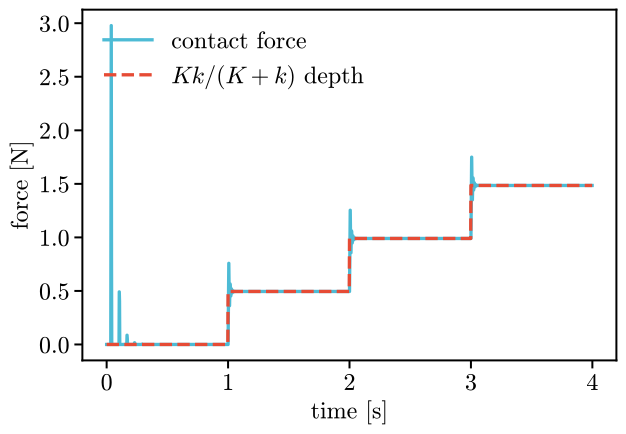
The first touch is an impact: the force peaks at 2.98 N while the tip stops, then settles. Each deeper goal raises the force by one step. The last one settles at 1.485 N against 1.485 N expected. To press more gently, lower \(K\) or damp the tip more.
This simulated finger delivers the full torque of its motors. A real transmission can pass on
less: the real finger’s motors deliver 84 % and 36 %
of their torque (adapt.MOTOR_EFFICIENCY), and the soft arm’s tendons a share \(\eta\) =
0.12. The
arm’s model does not need \(\eta\), because we identified its stiffness and damping from the
commanded torques. Its forces on the surroundings do need it. The spring presses with \(\eta K\)
times its stretch, so a chosen force needs \(1/\eta\) times the stretch, corrected for the arm’s
own stiffness and weight. The efficiency page explains both.
def draw(ax, row):
    ax.axhspan(0.06, 0.09, color="0.88", zorder=0)
    goal = [0.0, 0.05, 0.06 + row["depth"]]
    viz.draw_goal(ax, goal, plane="yz", markersize=10)
    at = kin.position(row["q"], "tip")
    viz.draw_force(ax, at, [0.0, 0.0, -row["force"]], plane="yz",
                   scale=0.015)

viz.animate(finger, log, "contact.mp4", plane="yz", invert=True,
            draw=draw, limits=((-0.01, 0.1), (-0.01, 0.085)))
Friction
A contact spring keeps the tip out of the table, and friction holds it back along the table.
ContactFriction(distance, stiffness, friction) is Coulomb friction, smoothed: a force against
the tip’s speed along the surface, of size \(\mu F_n\), with \(F_n\) the contact spring’s own force.
Give it the same Param for the stiffness as the spring has, so that they agree. A Param that
you make yourself is fixed unless you give it scope="stage", which means that it may change at
any control step (Parameters); a plain number given to a spring is stage
already. Below a small
speed, speed, 1 mm/s by default, the force falls linearly with it, so a tip at rest creeps
instead of sticking. We press
the tip 1.5 cm below the table and, after one second, move the goal along it at 5 mm/s:
mu = 0.5
rough = adapt.add_dynamics(adapt.finger())
rough_tip = rough.point("tip")
floor = vmc.PlaneDistance(rough_tip, normal=[0, 0, -1], origin=[0, 0, 0.06])
stiffness = vmc.Param("table", 1e4, unit="N/m", scope="stage")  # shared
rough.add("table", vmc.ContactSpring(floor, stiffness))
rough.add("cushion", vmc.ContactDamper(floor, 5.0))
rough.add("rub", vmc.ContactFriction(floor, stiffness, mu))

def moving_goal(t):  # 1.5 cm below the table, moving along it after 1 s
    return ca.vertcat(0.0, 0.05 - 0.005 * ca.fmax(t - 1.0, 0.0), 0.075)

drag = vmc.Mechanism("drag")
aim = vmc.Custom(moving_goal, [vmc.Time()], dim=3, unit="m")
drag.add("pull", vmc.LinearSpring(rough_tip - aim, 100.0))
drag.add("damp", vmc.LinearDamper(rough_tip, 1.0))
drag.add("limits", adapt.joint_limit_spring(rough))
drag.add("gravity", vmc.GravityCompensation(rough))
system = vmc.VirtualMechanismSystem(rough, drag)
controller = vmc.VMCController(vmc.compile(system))
plant = vmc.sim.ModelPlant(rough, q0=[0.8, 0.8], max_step=1e-4)
run_log = vmc.sim.run(plant, controller, vmc.sim.SimClock(1 / 500),
                      T=4.0, record=["elements", "robot"])
rows = run_log.arrays()
record="robot" makes the run log what the simulated robot itself feels, component by component,
as robot/<name>/force: here the table’s push and the friction. The controller’s own elements
are logged by record="elements", as element/<mechanism>.<component>/force.
t = np.ravel(rows["t"])
normal = rows["robot/table/force"][:, 0]  # [N], the table's push
rub = rows["robot/rub/force"][:, 1]  # [N], opposes the motion
along = rows["element/drag.pull/force"][:, 1]  # [N], the goal's spring

settled = t > 0.3  # leaves out the first bounces on the table
fig, ax = plt.subplots()
ax.plot(t[settled], -along[settled], lw=6, alpha=0.5,
        label="the goal's pull")
ax.plot(t[settled], rub[settled], label="friction")
ax.plot(t[settled], mu * normal[settled], "--", label=r"$\mu F_n$")
ax.set_xlabel("time [s]")
ax.set_ylabel("force along the table [N]")
ax.legend(loc="center right");
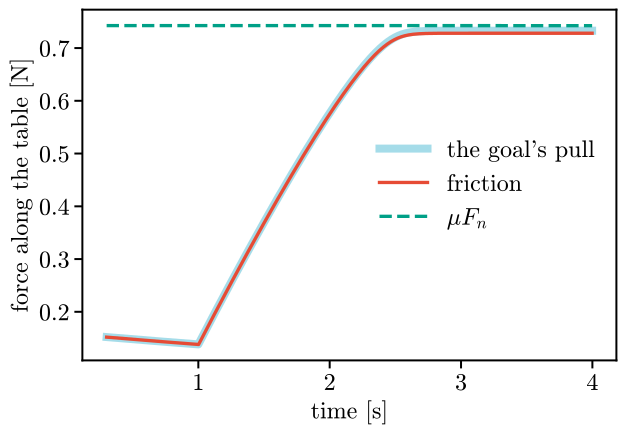
The goal moves away and the pull grows; friction grows with it and holds the tip, which creeps, until the pull reaches the limit \(\mu F_n\), 0.74 N here. Then the tip slides at the goal’s pace, with a friction of 0.73 N: a little under the limit, because the sliding speed of 5 mm/s is not far above the smoothing speed of 1 mm/s.
A virtual wall
The same two components on the controller make a floor that the fingertip may not cross, however deep its goal. The simulated finger has no table this time: only the controller’s floor stops it.
free = adapt.add_dynamics(adapt.finger())
tip = free.point("tip")
floor = vmc.PlaneDistance(tip, normal=[0, 0, -1], origin=[0, 0, 0.06])
k_floor = 2000.0  # [N/m], a gain like any other
depth = 0.015  # [m], the goal below the floor

ctrl = vmc.Mechanism("ctrl")
ctrl.add("press", vmc.LinearSpring(tip - [0.0, 0.05, 0.06 + depth], K))
ctrl.add("damp", vmc.LinearDamper(tip, 1.0))
ctrl.add("floor", vmc.ContactSpring(floor, k_floor))
ctrl.add("cushion", vmc.ContactDamper(floor, 5.0))
ctrl.add("gravity", vmc.GravityCompensation(free))
system = vmc.VirtualMechanismSystem(free, ctrl)
controller = vmc.VMCController(vmc.compile(system))

plant = vmc.sim.ModelPlant(free, q0=[0.8, 0.8], max_step=1e-4)
vmc.sim.run(plant, controller, vmc.sim.SimClock(dt=1 / 500), T=1.5)
past = 1000 * (vmc.Kinematics(free).position(plant.q, "tip")[2] - 0.06)
balance = 1000 * K * depth / (K + k_floor)  # [mm]
print(f"tip {past:.3f} mm past the floor;",
      f"K depth / (K + k_floor) = {balance:.3f} mm")
tip 0.714 mm past the floor; K depth / (K + k_floor) = 0.714 mm
The tip stops where the goal’s spring and the floor balance. The floor’s stiffness is a live
gain: controller.set changes it while running and returns the energy that the change adds
or removes.
Other surfaces
SphereDistance gives the distance to a ball, for grasps and obstacles. BoxDistance,
CapsuleDistance and CylinderDistance do the same for a box with its sides along the axes, a
capsule (a segment with a radius) and a cylinder. A body that can touch along its length, such
as a soft arm, takes a contact on several of its points. Any other signed distance written with
CasADi operations works through a Custom coordinate. Here is a pole of radius 2 cm along \(z\),
beside the soft arm’s tip:
from virtualmodelcontrol.robots import helyx

arm = helyx.add_dynamics(helyx.arm("145-145-145"))
pole = vmc.CylinderDistance(arm.point(s=1.0), center=[0.1, 0.0, 0.3],
                            axis=[0.0, 0.0, 1.0], radius=0.02,
                            half_height=0.5)
arm.add("pole", vmc.ContactSpring(pole, 2e4))
list(arm.components)  # the pole is now one of the arm's components
['m1', 'm2', 'm3', 'stiffness', 'damping', 'gravity', 'pole']
Between two points
A contact needs no fixed surface. Two points of the robot, or of two arms, meet when the distance
between them falls under a width, and ContactSpring(vmc.Norm(a - b) - width, k) pushes them
apart with the stiffness of whatever is between them. That is how the
two-arms example squeezes an object, and the same spring between two
points of one arm is a self-contact. Here two masses of 0.5 kg are pulled together by a virtual
spring and stop on an object 10 cm wide. The run logs the object’s force with record="robot":
pair = vmc.Mechanism("pair", model=vmc.models.JointSpace(2, unit="m"))
a, b = pair.joint(0), pair.joint(1)
for i, coord in enumerate((a, b)):
    pair.add(f"m{i}", vmc.Inertance(coord, 0.5))  # [kg]
distance = (b - a) - 0.10  # [m] to the object's surface; negative inside it
pair.add("object", vmc.ContactSpring(distance, 2e3))  # [N/m]
pair.add("cushion", vmc.ContactDamper(distance, 8.0))

squeeze = vmc.Mechanism("squeeze")
squeeze.add("pull", vmc.LinearSpring(b - a, 50.0))  # [N/m]
system = vmc.VirtualMechanismSystem(pair, squeeze)
controller = vmc.VMCController(vmc.compile(system))
plant = vmc.sim.ModelPlant(pair, q0=[0.0, 0.3], max_step=1e-4)
run_log = vmc.sim.run(plant, controller, vmc.sim.SimClock(1 / 500),
                      T=1.5, record="robot")
rows = run_log.arrays()
gap = rows["q"][:, 1] - rows["q"][:, 0]  # [m]
on_object = rows["robot/object/force"][:, 0]  # [N]
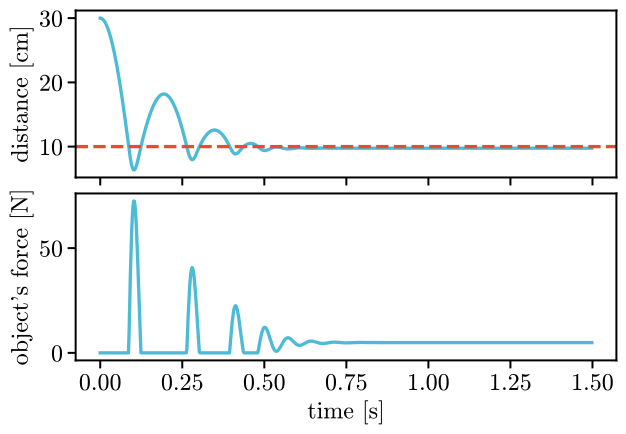
The masses stop 2.4 mm into the object, where its force, 4.88 N, equals the virtual spring’s pull: 50 N/m times the distance between the masses, 9.76 cm. An object with a mass of its own, or with several coordinates, is a part with its own joints in the robot, as in Joints and bodies; the contact is the same.
Friction between two points
Two points that touch can rub too, and the surface they rub on is a sphere around one of them.
vmc.SphereDistance(b - a, [0, 0, 0], width) is the same distance as Norm(b - a) - width, so
ContactFriction takes it, with the stiffness Param of the spring. It pushes the two points
with equal and opposite forces: it takes energy out of their sliding and nothing out of their
momentum. A mass of 1 kg hits one of 2 kg off center at 1 m/s, first without friction, then
with a coefficient of 0.4:
def collide(mu):
    robot = vmc.Mechanism("pair", model=vmc.models.JointSpace(6, unit="m"))
    a, b = robot.joint(slice(0, 3)), robot.joint(slice(3, 6))
    robot.add("ma", vmc.PointMass(a, 1.0))  # [kg]
    robot.add("mb", vmc.PointMass(b, 2.0))
    k = vmc.Param("k", 1e4, unit="N/m", scope="stage")
    robot.add("touch", vmc.ContactSpring(vmc.Norm(b - a) - 0.10, k))
    sphere = vmc.SphereDistance(b - a, [0.0, 0.0, 0.0], 0.10)
    robot.add("rub", vmc.ContactFriction(sphere, k, mu, speed=1e-4))
    system = vmc.VirtualMechanismSystem(robot, vmc.Mechanism("idle"))
    idle = vmc.VMCController(vmc.compile(system))
    plant = vmc.sim.ModelPlant(robot, q0=[0, 0, 0, 0.3, 0.04, 0],
                               v0=[1, 0, 0, 0, 0, 0], max_step=1e-4)
    return vmc.sim.run(plant, idle, vmc.sim.SimClock(1e-3), T=0.3).arrays()

def energy(rows):  # [J], kinetic
    first, second = rows["v"][:, :3], rows["v"][:, 3:]  # 1 kg and 2 kg
    return 0.5 * np.sum(first**2, axis=1) + np.sum(second**2, axis=1)

slick, grippy = collide(0.0), collide(0.4)
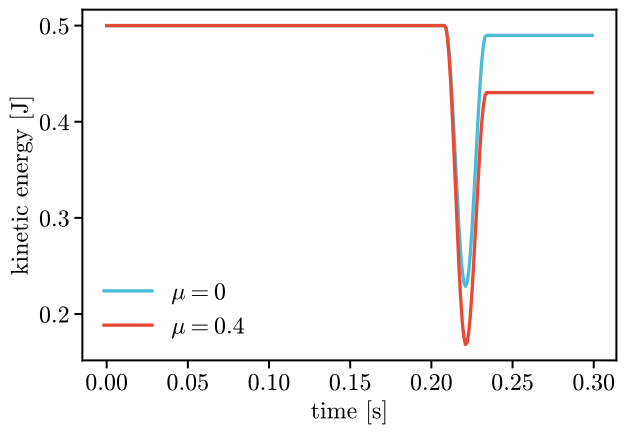
The energy dips while the spring holds some of it, and the frictionless pair gets back 98 % of it (the rest is the integrator’s). With friction the pair leaves with 86 %. The momentum is the same in both.
A soft object
A soft object is a part with coordinates and springs of its own. Here the object is 10 cm wide: each face is a point with a mass, the faces are joined by a spring, and each tip touches its face with a contact spring. The controller pulls the tips together with a spring of 50 N/m.
hold = vmc.Mechanism("hold", model=vmc.models.JointSpace(4, unit="m"))
tip_a, left, right, tip_b = (hold.joint(i) for i in range(4))
for i, coord in enumerate((tip_a, left, right, tip_b)):
    hold.add(f"m{i}", vmc.Inertance(coord, 0.5))  # [kg]
    hold.add(f"d{i}", vmc.LinearDamper(coord, 5.0))  # [N s/m]
hold.add("body", vmc.LinearSpring((right - left) - 0.10, 500.0))  # [N/m]
hold.add("face_a", vmc.ContactSpring(left - tip_a, 2e3))
hold.add("face_b", vmc.ContactSpring(tip_b - right, 2e3))

pull = vmc.Mechanism("pull")
pull.add("spring", vmc.LinearSpring(tip_b - tip_a, 50.0))  # [N/m]
controller = vmc.VMCController(
    vmc.compile(vmc.VirtualMechanismSystem(hold, pull)))
plant = vmc.sim.ModelPlant(hold, q0=[0.0, 0.05, 0.15, 0.2], max_step=1e-3)
run_log = vmc.sim.run(plant, controller, vmc.sim.SimClock(1 / 500),
                      T=4.0, record="robot")
rows = run_log.arrays()
At rest the same force goes through the contact, the object and the other contact: three springs in series, of 333 N/m together. The pull of 50 N/m balances them at a gap of 8.70 cm between the tips and a force of 4.35 N, of which the object itself takes up 8.7 mm of squeeze.
Choosing the numbers
Stiffness: the penetration at rest is \(F / k\); 10³ to 10⁵ N/m model hard surfaces, and a soft object is a lower \(k\).
Time step:
ModelPlant’s implicit steps stay stable at any stiffness. Resolving the impact needsmax_stepwell below the contact period \(2\pi\sqrt{m/k}\). A few grams on 10⁴ N/m give a few milliseconds, hencemax_step=1e-4above.Damping: the damping ratio is \(D / (2\sqrt{k m})\); without a contact damper the tip bounces.
Smoothing:
ContactSpring(d, k, smoothing=w)andContactDamper(d, D, smoothing=w)round the corner at the surface over a distance \(w\) [m], which optimization needs.Friction: a contact spring pushes along the normal only, so a pressing tip can slide. Add a
ContactFrictionon the same surface, with the spring’s stiffnessParam;speedis the sliding speed below which the force falls linearly, so a point at rest creeps.
To hold a chosen contact force without computing the depth of the goal, see Track a contact force.