
Finger: fingertip stiffness and joint limits
In this example we give the ADAPT finger a stiff fingertip with a virtual spring, and keep its joints inside their ranges with joint-limit springs.
The robot
The ADAPT finger has three phalanges and two motors: motor 0 turns the first joint (MCP) through a pulley, and motor 1 turns the other two (PIP and DIP) together through a cable. Its configuration is the two motor angles \(q_0, q_1\).
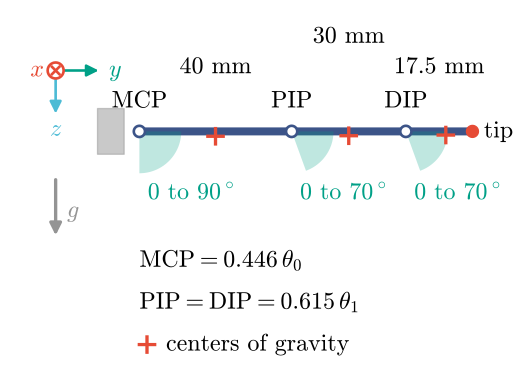
The drawing shows the finger straight, as mounted: its \(z\) axis points down, along gravity, and a positive joint angle bends the finger down. The wedges are the ranges of the joints. These are the Params of the finger, read from the template:
Param |
Value |
Unit |
Meaning |
|---|---|---|---|
|
[1, 0, 0] |
1 |
axis of the MCP joint (also |
|
[0, 0.04, 0] |
m |
PIP joint, at the end of the proximal phalanx |
|
[0, 0.07, 0] |
m |
DIP joint, at the end of the middle phalanx |
|
[0, 0.0875, 0] |
m |
fingertip, at the end of the distal phalanx |
|
3 × 2 matrix |
1 |
joint angles (MCP, PIP, DIP) per motor angle |
|
0.0057 |
kg |
mass of the proximal phalanx |
|
0.004 |
kg |
mass of the middle phalanx |
|
0.025 |
kg |
mass of the distal phalanx |
|
[-0.000716, 0.0805, 0.000955] |
m |
center of gravity of the distal phalanx (also |
|
[0, 0, 9.81] |
m/s² |
gravity in the finger’s frame, as mounted |
On the real finger, adapt.output_stage() adds a friction feed-forward of
0.20 N·m in the direction of each command, which fades out once the motor
turns faster than about 0.03 rad/s, then clips the commands to
±0.8 N·m. The simulations below leave it out.
The motors pass on only part of their torque: 84 % at the MCP and
36 % at the PIP (adapt.MOTOR_EFFICIENCY), fitted to measured fingertip
forces. The template’s efficiency is 1, the default of every template, so the simulations below
deliver the full torque. With a different efficiency on each of two motors that one virtual
spring couples, the force the finger receives no longer derives from the spring’s energy, and a
simulated finger can start to vibrate. adapt.finger(efficiency=adapt.MOTOR_EFFICIENCY)
includes the efficiencies.
The template takes its geometry and transmission as arguments. A longer finger with a larger pulley on the MCP joint, for example, has a new first coupling ratio: the MCP joint turns by the pulley’s radius over the motor pulley’s per motor angle, \(3 / 5 = 0.6\) in place of the default 2.23 / 5 = 0.446:
import numpy as np
import virtualmodelcontrol as vmc
from virtualmodelcontrol.robots import adapt

longer = adapt.finger(link_lengths=(0.045, 0.035, 0.02),  # [m]
                      pulley_radius=0.003)  # [m], on the MCP joint
default = adapt.finger().params["coupling"].value.round(3)
default, longer.params["coupling"].value.round(3)  # before and after
(array([[0.446, 0.   ],
        [0.   , 0.615],
        [0.   , 0.615]]),
 array([[0.6  , 0.   ],
        [0.   , 0.615],
        [0.   , 0.615]]))
A new pulley comes with a new ratio, which a sweep measures: set the MCP joint to known angles,
read the motor’s, and fit_transmission gives the joint angle per motor angle, the first entry
of the coupling. Here is the finger’s own sweep (the motor angles that went with joints at 0° to
75° in steps of 15°):
from virtualmodelcontrol.identification import fit_transmission

joint = [0, 15, 30, 45, 60, 75]  # [deg], set
motor = [0, 40.07, 69.96, 99.93, 129.99, 170.07]  # [deg], read
ratio = fit_transmission(motor, joint)
radius = 1e3 * adapt.MOTOR_RADIUS * ratio  # [mm]
f"ratio {ratio:.4f}, pulley radius {radius:.2f} mm"
'ratio 0.4459, pulley radius 2.23 mm'
A stiff fingertip
A spring pulls the fingertip to a goal, a damper on the tip slows it down, and gravity
compensation cancels the weight of the phalanges. adapt.add_dynamics gives the simulated
finger its gravity and a viscous damping on the motors, whose value here is only illustrative.
finger = adapt.add_dynamics(adapt.finger(), damping=0.001)  # [N·m·s/rad]
tip = finger.point("tip")

def fingertip(goal, limits=False):
    ctrl = vmc.Mechanism("ctrl")
    ctrl.add("tip", vmc.LinearSpring(tip - goal, 100.0))  # [N/m]
    ctrl.add("damp", vmc.LinearDamper(tip, 1.0))  # [N·s/m]
    if limits:
        ctrl.add("limits", adapt.joint_limit_spring(finger))
    ctrl.add("gravity", vmc.GravityCompensation(finger))
    return ctrl

def simulate(ctrl, q0=None):
    system = vmc.VirtualMechanismSystem(finger, ctrl)
    controller = vmc.VMCController(vmc.compile(system))
    plant = vmc.sim.ModelPlant(finger, q0=q0)
    clock = vmc.sim.SimClock(dt=1 / 500)
    return vmc.sim.run(plant, controller, clock, T=1.0)

q = simulate(fingertip([0.0, 0.04, 0.06])).arrays()["q"][-1]  # goal [m]
kin = vmc.Kinematics(finger)
kin.position(q, "tip").round(4), np.degrees(adapt.COUPLING @ q).round(1)
(array([0. , 0.04, 0.06]), array([23.7, 45.5, 45.5]))
The fingertip settles on the goal, and the joint angles (MCP, PIP, DIP, in degrees) stay inside their ranges, with PIP and DIP turning together.
Joint limits
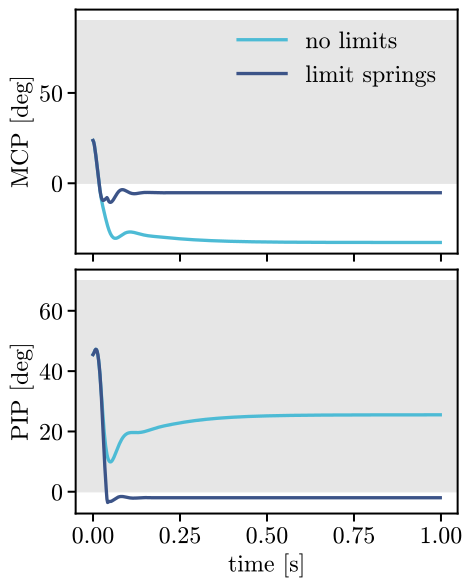
A goal above the finger asks it to bend back at the MCP, out of its range.
adapt.joint_limit_spring adds springs on the three joint angles. They do nothing inside the
ranges and push a joint back once it leaves its range. We start from where the finger stopped,
without and with them, and plot the joint angles against their ranges (shaded):
import matplotlib.pyplot as plt
from virtualmodelcontrol import viz

above = [0.0, 0.08, -0.02]  # [m], z points down
runs = {"no limits": simulate(fingertip(above), q0=q),
        "limit springs": simulate(fingertip(above, limits=True), q0=q)}
colors = (viz.PALETTE[0], viz.PALETTE[3])
fig, axes = plt.subplots(2, 1, figsize=(4.8, 6.0), sharex=True)
for (label, log), color in zip(runs.items(), colors):
    rows = log.arrays()
    angles = np.degrees(rows["q"] @ adapt.COUPLING.T)  # MCP, PIP, DIP
    for k, ax in enumerate(axes):
        ax.plot(rows["t"], angles[:, k], color=color, label=label)
for ax, joint in zip(axes, ("MCP", "PIP")):
    ax.axhspan(*np.degrees(adapt.JOINT_LIMITS[joint]), color="0.9")
    ax.set_ylabel(f"{joint} [deg]")
axes[1].set_xlabel("time [s]")
axes[0].legend();
The paths of the fingertip, with the finger where each run ends:
fig, ax = plt.subplots(figsize=(4.8, 4.8))
for (label, log), color in zip(runs.items(), colors):
    qs = log.arrays()["q"]
    path = np.array([kin.position(x, "tip") for x in qs])
    ax.plot(path[:, 1], path[:, 2], color=color, lw=1.5)
    viz.draw_robot(ax, finger, qs[-1], plane="yz", color=color, label=label)
viz.draw_goal(ax, above, plane="yz")
ax.invert_yaxis()  # as mounted: z points down
viz.label_axes(ax, "yz")
ax.legend(loc="lower left");
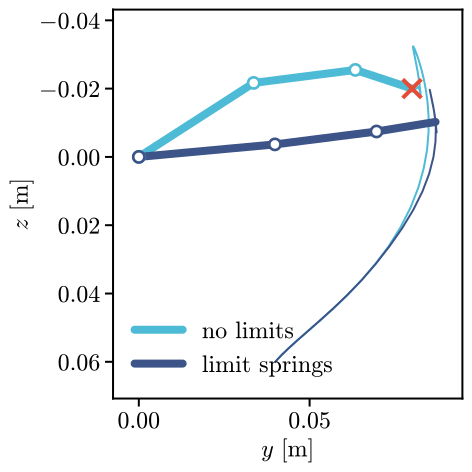
Without limit springs the MCP bends back to -33° and the fingertip reaches
the goal. With them, the joints stop just past the ends of their ranges (MCP at
-5°), where the limit springs balance the fingertip spring, and the tip stays
12 mm short of the goal. A stiffer limit spring (its stiffness argument)
keeps the joints closer to their ranges.
Press with a chosen force
The lab tracks a fingertip force on a load cell with two laws that both descend the force error at a fixed learning rate: at every control step a Param moves by the learning rate times its gradient (the force tracking tutorial explains the law). One law changes the joint-space stiffness, which changes the slope of the force against the displacement. The other moves the joint reference and leaves the stiffness alone. Here the load cell is a table, 6.3 cm below the finger’s base, that the fingertip touches at joint angles of 30°. A joint-space spring holds the finger 12° beyond that, which presses on it.
from virtualmodelcontrol.adaptation import ForceTracking

hz = adapt.FINGER_CONTROL_RATE  # [Hz]
rig = adapt.add_dynamics(adapt.finger(), damping=0.001)
touch = np.radians([30.0, 30.0, 30.0])  # joint angles at first contact
q_touch = np.linalg.lstsq(adapt.COUPLING, touch, rcond=None)[0]
table_z = vmc.Kinematics(rig).position(q_touch, "tip")[2]  # [m]
k_table = 1e4  # [N/m]
gap = vmc.PlaneDistance(rig.point("tip"), normal=[0, 0, -1],
                        origin=[0, 0, table_z])
rig.add("table", vmc.ContactSpring(gap, k_table))
rig.add("cushion", vmc.ContactDamper(gap, 5.0))  # [N·s/m]

joints = adapt.joint_angles(rig)
target = vmc.Ref("theta_ref", 3, value=np.radians([42.0] * 3), unit="rad")
ctrl = vmc.Mechanism("ctrl")
K = 0.2 * np.eye(3)  # [N·m/rad]
ctrl.add("hold", vmc.LinearSpring(joints - target, K))
ctrl.add("damp", vmc.LinearDamper(joints, 0.003))  # [N·m·s/rad]
ctrl.add("gravity", vmc.GravityCompensation(rig))
compiled = vmc.compile(vmc.VirtualMechanismSystem(rig, ctrl))
The wanted force steps from 0.5 N to 0.8 N after 10 s. The loop reads the table’s force, as the load cell does, and starts the law after a second. The learning rates, 1e-4 for the stiffness and 5e-5 for the reference, are the lab’s for this finger at 900 Hz:
levels = (0.5, 0.8)  # [N]

def track(adapted, learning_rate, hold=10.0):
    controller = vmc.VMCController(compiled)
    law = ForceTracking(controller, "tip", adapted, normal=[0, 0, 1],
                        rate=learning_rate)
    plant = vmc.sim.ModelPlant(rig, q0=0.8 * q_touch, max_step=2e-4)
    kin, log = vmc.Kinematics(rig), []
    for _ in range(int(len(levels) * hold * hz)):
        plant.write(controller.step(plant.t, plant.read()))
        below = kin.position(plant.q, "tip")[2] - table_z  # [m]
        force = np.array([0.0, 0.0, k_table * max(0.0, below)])
        wanted = levels[int(plant.t // hold)]
        if plant.t > 1.0:
            law.step(controller, force, [0.0, 0.0, wanted])
        log.append((plant.t, force[2], wanted))
        plant.advance(1 / hz)
    return np.array(log), controller.live_params()

by_stiffness, stiffness = track("ctrl.hold.stiffness", 1e-4)
by_reference, reference = track("ctrl.hold.theta_ref", 5e-5)
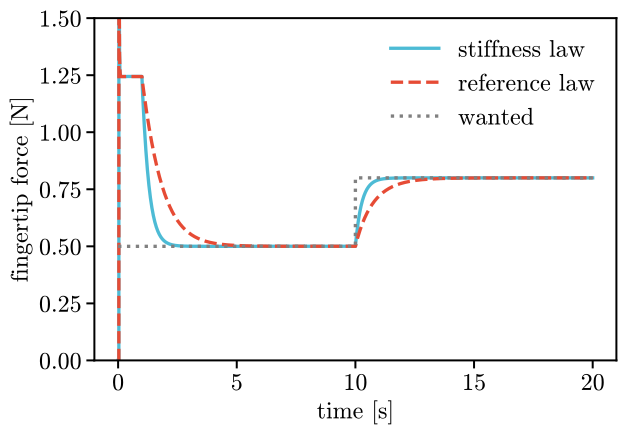
The finger lands on the table (the spike at the start, cut off in the plot) and holds 1.24 N until the laws start. Both laws then reach each level, and they get there differently. The stiffness law ends with the diagonal of its stiffness at 0.129, 0.198 and 0.198 N·m/rad, from 0.2 each, and leaves the reference at 42°. The reference law ends with the joint targets at 37.0°, 43.6° and 43.6°, and leaves the stiffness alone. A different finger, sensor or rate needs learning rates of its own.
Animate
plane="yz" shows the finger from the side and invert=True turns \(z\) down, as mounted.
speed=0.25 slows the run down four times.
viz.animate(finger, runs["limit springs"], "finger.mp4", plane="yz",
            invert=True, springs=[("tip", above)], trace="tip", speed=0.25,
            figsize=(5.0, 5.0))